
What We Learned from the Largest Cohort of Genotyped CI Recipients
Genetic Insights into Cochlear Implant Outcomes
Overview
What determines how well someone hears after receiving a cochlear implant (CI)? In our newly published study, Cochlear Implantation Outcomes in Genotyped Subjects with Sensorineural Hearing Loss, we analyzed data from 220 individuals with hereditary sensorineural hearing loss (SNHL), each with a known genetic diagnosis involving one or more of 31 nuclear or mitochondrial genes.
Our goal: to understand how cochlear implant outcomes relate to both genetic causes and individual characteristics—and to assess whether the cochlear site-of-lesion (as inferred from gene function) helps explain variability in performance.
 Figure 1. Pre- and post-synaptic components of the cochlea. The transverse section through the middle turn of the cochlea shows the pre-synaptic components of the cochlea in blue, including the stria vascularis and organ of Corti, and the post-synaptic parts in red, including the spiral ganglion neurons that eventually form the cochlear nerve. Figure created in BioRender. Fehrmann, M. (2025) https://BioRender.com/e54j431.
Key Findings at a Glance
- Most genotyped CI recipients performed very well. The median phoneme score at 65 dB SPL in quiet was 90%, with many individuals reaching scores above 95%.
- Early implantation is beneficial. Individuals who received their implant before age 6 performed better and showed less variability.
- Cochlear site-of-lesion did not explain variability. Models with site-of-lesion (pre-synaptic, post-synaptic, mitochondrial) as a factor explained virtually none of the variance in CI outcomes (R² = 0.000, p = 0.938).
- Subject-specific factors matter most. A multivariate regression model including age at implantation, sex, CI experience (years), hearing aid use before implantation, and self-reported SNHL duration explained 19% of the variability in CI outcomes.
- Findings align with existing literature. Results are consistent with earlier work (e.g., Lazard et al.) emphasizing the strong influence of auditory history and environmental factors.
CI Outcomes per Gene
We visualized CI outcomes per gene in Figure 2 below, which shows median phoneme scores and individual data points for each gene, ranked from best to worst outcomes. While most genes were associated with good performance, a few (e.g., MYO3A, OTOF, USH1C, OPA1) showed wider variability and lower median scores. Yet these poorer outcomes were largely explained by subject-level factors such as prelingual deafness with late implantation, lack of auditory stimulation, or psychosocial factors.
We excluded genes with dual site-of-lesion associations from this figure, including COCH (N = 37 ears), CLRN1 (N = 6), and WFS1 (N = 7), to avoid bias due to uncertain categorization.
 Figure 2. CI outcomes per gene, sorted by median phoneme score (high-to-low) and color by site-of-lesion. Dots represent individual ears.
Implications for Clinical Practice
These findings offer reassurance to clinicians and patients alike: most individuals with hereditary hearing loss can expect excellent CI outcomes, regardless of the precise genetic etiology.
However, timing and support are critical. Early implantation, consistent use of hearing aids prior to surgery, and a strong support system were all associated with better outcomes. In contrast, delayed implantation, prolonged auditory deprivation, and limited psychosocial support were common among lower performers.
The site-of-lesion hypothesis remains a promising framework for future research, but current data suggest it has limited predictive value when applied clinically. Improved models—possibly integrating neural integrity tests or human-derived organoid models—are needed to fully understand genotype-phenotype relationships in auditory rehabilitation.
Our study reinforces a central message in auditory care: while genes provide important diagnostic information, they are only part of the story. A personalized, timing-sensitive, and supportive approach remains key to maximizing cochlear implant outcomes.
About the Dissertation — PhDone
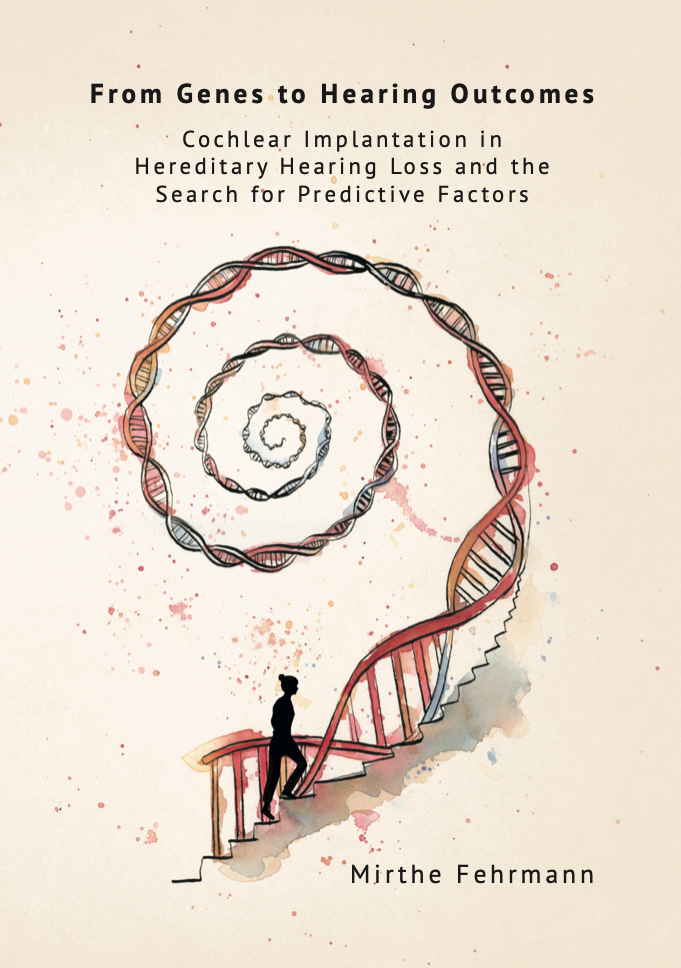
This work was part of the doctoral research by Mirthe Fehrmann, who successfully defended her PhD dissertation titled From Genes to Hearing Outcomes: Cochlear Implantation in Hereditary Hearing Loss and the Search for Predictive Factors on June 3, 2025, at Radboud University. Needless to say, I’m proud of her achievements (7 papers (!), see below), her ability to manage supervisors, and for a beautiful thesis (see cover below) providing an in-depth analysis of genetic and individual factors shaping CI success.
Supervised by Prof. Mylanus, Prof. Pennings, Dr. Huinck, and myself, the dissertation is now available via the Radboud repository. You can read the full dissertation at https://hdl.handle.net/2066/319710.
Publications
Journal Articles
-
Fehrmann, M., Beynon, A., Huinck, W., Pennings, R., Mylanus, E., & Lanting, C. (2025). The Potential of Electrocochleography in Explaining the Variability in Cochlear Implant Outcomes: A Scoping Review. International Journal of Audiology, 1–15. https://doi.org/10.1080/14992027.2025.2459223
-
Fehrmann, M. L. A., Haer-Wigman, L., Kremer, H., Yntema, H. G., Thijssen, M. E. G., Mylanus, E. A. M., Huinck, W. J., Lanting, C. P., & Pennings, R. J. E. (2025). Cochlear Implantation Outcomes in Genotyped Subjects with Sensorineural Hearing Loss. Journal of the Association for Research in Otolaryngology. https://doi.org/10.1007/s10162-025-00987-0
-
Wijn, D. H., Fehrmann, M. L. A., Robijn, S. M. M., Velde, H. M., Smits, J. J., van Wijk, E., Beynon, A. J., Cals, F. L. J., Hoyng, C. B., Yzer, S., Lanting, C. P., & Pennings, R. J. E. (2025). From Sound to Stability: Lessons Learned From the CRUSH Study on Hearing Loss Progression and Vestibular Phenotype in Usher Syndrome Type 2A. Otology & Neurotology, 10.1097/MAO.0000000000004851. https://doi.org/10.1097/MAO.0000000000004851
-
Colbert, B. M., Lanting, C., Smeal, M., Blanton, S., Dykxhoorn, D. M., Tang, P.-C., Getchell, R. L., Velde, H., Fehrmann, M., Thorpe, R., Chapagain, P., Elkhaligy, H., Kremer, H., Yntema, H., Haer-Wigman, L., Redfield, S., Sun, T., Bruijn, S., Plomp, A., … Liu, X. Z. (2024). The Natural History and Genotype–Phenotype Correlations of TMPRSS3 Hearing Loss: An International, Multi-Center, Cohort Analysis. Human Genetics, 143(5), 721–734. https://doi.org/10.1007/s00439-024-02648-3
-
Fehrmann, M. L. A., Meijer, F. J. A., Mylanus, E. A. M., Pennings, R. J. E., Lanting, C. P., & Huinck, W. J. (2024). Evaluating Cochlear Implant Outcomes in DFNA9 Subjects: A Comprehensive Study on Cerebral White Matter Lesions and Vestibular Abnormalities. European Archives of Oto-Rhino-Laryngology. https://doi.org/10.1007/s00405-024-08933-1
-
Fehrmann, M. L. A., Lanting, C. P., Haer-Wigman, L., Mylanus, E. A. M., Huinck, W. J., & Pennings, R. J. E. (2024). Good Cochlear Implantation Outcomes in Subjects with Mono-Allelic WFS1- Associated Sensorineural Hearing Loss – a Case Series. International Journal of Audiology, 1–9. https://doi.org/10.1080/14992027.2024.2411579
-
Fehrmann, M. L. A., Lanting, C. P., Haer-Wigman, L., Yntema, H. G., Mylanus, E. A. M., Huinck, W. J., & Pennings, R. J. E. (2024). Long-Term Outcomes of Cochlear Implantation in Usher Syndrome. Ear and Hearing, 10.1097/AUD.0000000000001544. https://doi.org/10.1097/AUD.0000000000001544
-
Fehrmann, M. L. A., Huinck, W. J., Thijssen, M. E. G., Haer-Wigman, L., Yntema, H. G., Rotteveel, L. J. C., Widdershoven, J. C. C., Goderie, T., Van Dooren, M. F., Hoefsloot, E. H., Van Der Schroeff, M. P., Mylanus, E. A. M., DOOFNL consortium, Van Dooren, M. F., Kant, S. G., De Gier, H. H. W., Hoefsloot, E. H., Van Der Schroeff, M. P., Rotteveel, L. J. C., … Pennings, R. J. E. (2023). Stable Long-Term Outcomes after Cochlear Implantation in Subjects with TMPRSS3 Associated Hearing Loss: A Retrospective Multicentre Study. Journal of Otolaryngology - Head & Neck Surgery, 52(1), 82. https://doi.org/10.1186/s40463-023-00680-3
Cris
RESEARCH · COCHLEAR-IMPLANTS
genetics hearing loss cochlear implants auditory rehabilitation site-of-lesion SNHL